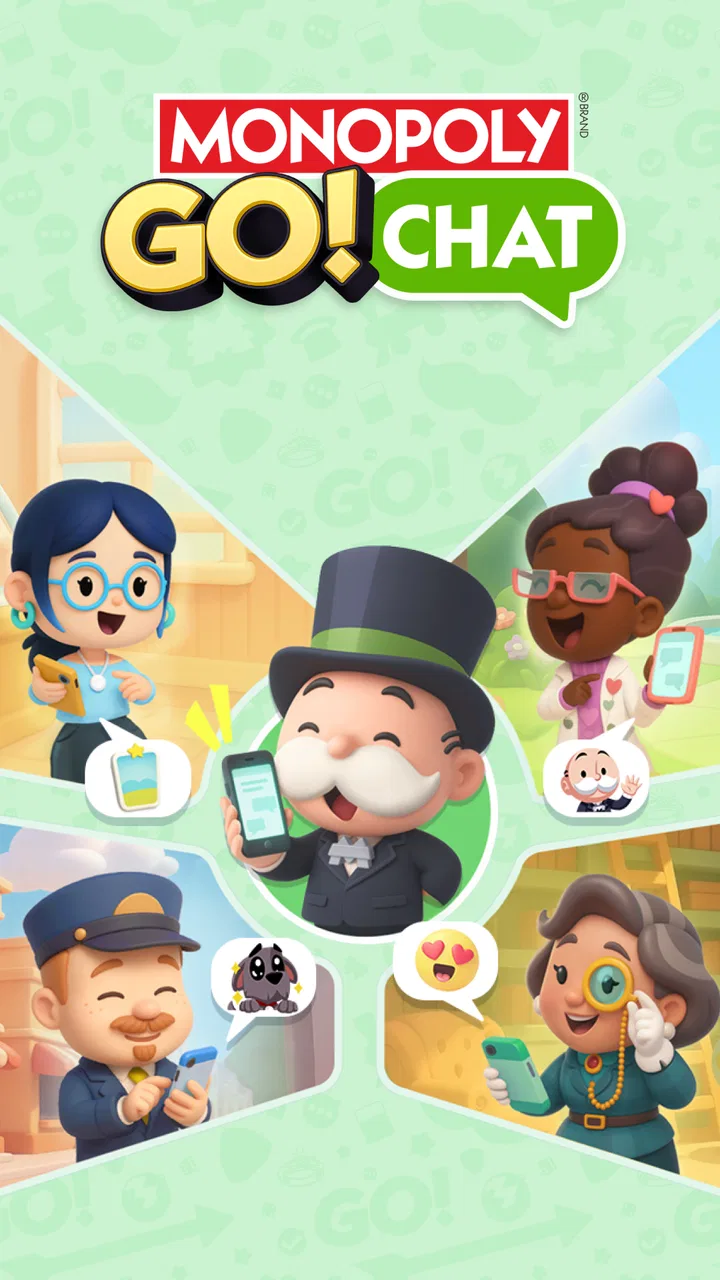
MONOPOLY GO!Chat
- 4.5
- Rating
- 1.00M
- Installs
- Free
- Price

 Analysis by App-foxy
I tried MONOPOLY GO!Chat as a companion communication app for people who already spend time in MONOPOLY GO!, and its purpose became clear quickly: it is designed to keep friends and teammates in one shared conversation instead of forcing every coordination message into a separate social app. That focus makes it more interesting than a generic chat client, but also much narrower. I would not install it as my main messenger. I would consider it when the people I play with are already using MONOPOLY GO! and need a simple place to organize their sessions.
The app sits in the communication category and comes from Scopely, the developer behind the MONOPOLY GO! experience it supports. It is free to install, carries an Everyone age rating, and runs on Android 7.0 or later. The current release is version 0.7.0, so I would approach it as a focused companion that may still feel relatively early in its development rather than as a mature replacement for established messaging platforms.
How MONOPOLY GO!Chat fits into a player's routine
I’d use this section to focus on the small moments when a dedicated game chat can earn its place: checking who is available before playing, keeping plans separate from unrelated messages, and making sure everyone knows where to reply. The key test is whether the whole team adopts that habit; next, I’d look at what the app’s current release does—and does not yet establish.
You May Also Like

 Google Keep - Notes and lists
Google Keep’s Quiet Growth Shows the Appeal of Simpler Notes
As mobile work gets busier, Google Keep keeps winning a simple contest: capture a thought quickly, find it later, and get on with the day.

 Blood Strike: 2.5 Anniversary
Blood Strike’s Loadouts Turn Every Drop Into a Tactical Gamble
A close look at Blood Strike’s custom loadouts: how fast access to signature weapons reshapes its battle royale rhythm, rewards preparation, and narrows the gap between fights.

 Pandora - Music & Podcasts
Pandora’s Music Is Easy to Start, but Harder to Recover
Pandora’s strength is its low-effort path from a seed to a station. Its weak spot is how much confidence it asks you to place in connection, setup, and quiet recovery.

 8 Ball Pool
 Is Built on Rivalries, Rematches, and Routine
A close look at the rivalries, rematches, shared routines, and unanswered safety questions that turn a quick pool match into a persistent mobile community.

 Samsung Music
’s Quiet Strength Is Playing What You Already Own
Its reach comes less from spectacle than from dependable access to a personal library. That simplicity is both the app’s strongest retention engine and its ceiling.

 AccuWeather: Weather Radar
AccuWeather Review: A Quick, Clear Forecast for Everyday Decisions
For everyday plans, the best forecast is the one you can understand quickly. AccuWeather makes rain timing, radar, and local conditions easy to act on, with a few trade-offs.
More From Our News Desk



A focused room for friends and teammates
The strongest idea here is context. A normal messaging app makes me create a group, name it, explain which game we are discussing, and then keep track of invitations or requests among unrelated conversations. A game-linked chat has a more obvious reason to exist: talk to the people I play with, coordinate activity, and keep the conversation connected to the team experience.
That can be useful for casual groups that do not want a full community server. A few friends can use the app to decide when to play, remind one another about an event, or discuss a cooperative objective without mixing those messages with family, work, and other gaming communities. The value is not that it replaces every communication tool. The value is that it reduces the distance between the conversation and the game it supports.
In my view, this distinction matters. If I only play MONOPOLY GO! occasionally and already have a comfortable group chat, adding another app creates another place to check. If my regular teammates are all using this companion, however, the dedicated setting can make coordination feel less scattered. The app makes most sense when the group adopts it together, not when one person installs it alone and expects the community to appear automatically.
A realistic everyday example
Imagine a small group that plays after dinner. One person notices that the team needs better coordination, so they open the chat before starting a session and ask who is available. Another player replies while commuting, and a third joins later after finishing homework. The group can settle on a time, share a reminder, and keep the discussion in one place rather than sending separate messages through a general-purpose app.
That workflow sounds simple, but simplicity is exactly where a dedicated companion can help. I do not need a large server structure for a handful of teammates. I also do not need to expose the rest of my personal conversations to people I know mainly through the game. For a stable group, this separation can be a genuine convenience.
At the same time, the scenario depends on everyone agreeing to use the same channel. If two teammates prefer an existing messenger, the benefit becomes much smaller. A chat app is only as useful as the people who answer in it, and MONOPOLY GO!Chat does not magically solve the social problem of getting a group to move platforms.
What the free price means in practice
The app is free, which removes the most obvious barrier to trying it. I can test whether my group finds it useful without paying an entry fee, and that is important for a companion app whose usefulness depends on shared adoption. Free access also makes it easier to suggest to a casual teammate who may not want another subscription or paid utility.
Still, free should not be confused with guaranteed value. The practical return comes from whether conversations are active and whether the app saves time compared with the tools my group already uses. If my friends are already organized in a familiar messenger, installing a second free app may cost attention rather than money. The real question is not “does it cost anything?” but “does it make our gaming routine easier?”
I would also avoid treating the free label as a promise about every possible aspect of long-term use. The confirmed price is free, and that is enough to justify trying it. It does not, by itself, tell me how the experience will evolve or whether every future capability will remain equally accessible. For a purchase decision, my recommendation is straightforward: try it with the people you actually play with, then keep it only if it earns a regular place in your routine.
Where the value comes from
The app delivers its clearest value through concentration. A dedicated space can make it easier to remember who is on the team, keep game-related messages together, and avoid the clutter of a much larger social platform. That is especially helpful for players who want communication without building a complicated community around a casual game.
Another useful trade-off is privacy of context. I may be happy to chat with teammates about play sessions without inviting them into a broader personal group. A separate app gives that relationship its own boundary. I still need to use sensible judgement about what I share, but the separation itself can make the social arrangement more comfortable.
There is also a psychological advantage to a purpose-built channel. When I open a general messenger, I may be distracted by unrelated notifications. When I open a game companion, my intention is clearer: check in with the group and deal with the gaming conversation. That does not make the app technically superior to every alternative, but it can make the routine easier to maintain for players who prefer dedicated spaces.
Three practical habits that improve the experience
My first tip is to agree on one communication rule before inviting everyone. For example, the group can decide that scheduling messages go in the dedicated chat while urgent personal matters stay in the usual messenger. Without that agreement, the same conversation may split between two apps, which defeats the purpose of installing a focused companion.
My second tip is to use the chat as a coordination layer rather than a replacement for the game itself. I would open it before a session to confirm availability, then return to it afterward to record what the group wants to do next. This keeps messages purposeful and prevents the companion from becoming a noisy stream of reactions that nobody checks.
My third tip is to test it with a small, reliable group first. A large invite list can make the app look active while leaving the actual coordination unclear. Starting with the teammates who regularly respond gives me a better way to judge whether the app improves communication. If the core group does not use it, adding more contacts is unlikely to fix the problem.
Trade-offs compared with familiar alternatives
Compared with a standard messenger, MONOPOLY GO!Chat has a narrower identity. A general app is usually better when my contacts discuss several games, share files, make voice or video calls, or need one place for family, work, and hobbies. It is also more convenient when the group already has years of conversation history in that service.
Compared with a large gaming community platform, this app may appeal to people who dislike complicated channels, roles, and moderation settings. A small team does not always need a public server or a structured community. The trade-off is that a broader platform may offer richer tools for large groups, persistent resources, voice coordination, and communities that extend beyond one title.
Compared with using the game alone, a separate chat can give the social side more room. In-game communication is often tied closely to immediate play, while a companion conversation can cover planning before a session and follow-up afterward. However, every additional app introduces another notification stream and another account or interface to manage. Players who prefer the smallest possible setup may reasonably decide that the game and their existing messenger are enough.
Friction I would consider before installing
The biggest limitation is dependence on a specific player community. This is not a broad communication tool that becomes useful simply because I have contacts. Its appeal is tied to MONOPOLY GO! players, especially friends and teammates who are willing to participate. Someone who rarely plays with others may receive very little benefit.
There is also a discovery problem. A dedicated chat is effective only when I know whom to contact and when those people are willing to respond there. If my group is spread across different platforms, the app can become a quiet inbox rather than a lively coordination space. I would therefore ask my regular teammates first instead of installing it in isolation.
The early version number also makes me cautious about treating the app as a finished, all-purpose communication suite. I would judge it by the quality of its core conversation workflow, not by expecting it to match every mature alternative. That is not a criticism of the concept; it is a reminder to keep expectations aligned with a focused companion application.
Who is likely to get the most value?
I think the best audience is a group of friends or teammates who play together often and want a dedicated place to coordinate. It is particularly suitable for players who find general social apps distracting, who do not need a large public community, and who are comfortable adding one more app for one specific hobby.
It can also work for casual groups that want a low-commitment trial. Because the app is free, the group can test a simple routine without negotiating a purchase. If conversations become easier to follow and more people respond consistently, the installation has justified itself through convenience rather than through extra game content.
I would be less enthusiastic for solo players, people whose teammates are already committed to another messenger, and users seeking a complete replacement for their main communication service. It is also not my first choice for a large gaming community that needs advanced organization or communication beyond the MONOPOLY GO! setting. In those cases, a general messenger or established gaming platform is likely to provide broader value.
What I would check during the first week
After installing, I would invite only the teammates who are most likely to participate and observe three things: whether messages receive timely replies, whether the group actually coordinates more clearly, and whether the extra app reduces or increases confusion. Those tests are more meaningful than simply opening the app once and deciding that a chat interface looks familiar.
I would also pay attention to notification habits. If alerts arrive at inconvenient times, I would adjust them rather than allowing the app to become irritating. A companion should support the game, not pressure me to monitor it constantly. The best setup is one where I can check the conversation at a sensible time and still know what the group has decided.
Finally, I would compare the result with the tool my group already uses. If the dedicated chat makes planning faster, keeps game messages easier to find, and encourages teammates to participate, it has a clear role. If the same people continue replying elsewhere, the free installation has still been harmless to test, but it has not earned permanent space on my phone.
My verdict for Android users
MONOPOLY GO!Chat is worth trying when the social part of MONOPOLY GO! is important to me and my regular teammates are willing to meet in one dedicated conversation. Its free price makes experimentation easy, and its focused communication purpose can be more comfortable than mixing game planning with unrelated personal messages.
My recommendation is more cautious if I am looking for a universal messenger. This app is not the right choice simply because I need to chat; it is the right choice because I want a focused channel for this particular game community. The distinction matters. A familiar general-purpose app remains better for mixed groups, broader gaming interests, and richer communication needs.
With an average rating of 4.4 from around 2.2 thousand ratings and more than one million installs, it has already attracted a meaningful audience, while its Everyone rating keeps the intended audience broad. I would read those figures as a reason to test the app, not as a guarantee that my own group will adopt it.
My final decision is a qualified yes: install it for a small, active MONOPOLY GO! team, establish a clear communication routine, and keep it only if it genuinely reduces coordination friction. Skip it if your group already works well elsewhere or if you want a full-featured social platform. The app’s value is real, but it comes from shared use and focused purpose rather than from being a universal replacement for every chat service.
FAQs for MONOPOLY GO!Chat
01What is MONOPOLY GO!Chat and how does it differ from the classic Monopoly game?
MONOPOLY GO!Chat is a modern twist on the classic Monopoly board game, tailored for mobile devices. It offers a real-time multiplayer experience, allowing players to interact with friends through in-game chat features. Unlike the traditional game, this version includes new mini-games, customizable boards, and dynamic events that keep gameplay fresh and engaging.
02Can I play MONOPOLY GO!Chat offline, or do I need an internet connection?
MONOPOLY GO!Chat requires an internet connection to access its full features, including multiplayer modes and real-time chat. While some basic functionalities might be accessible offline, such as viewing your game stats or customizing your board, the core interactive experience is designed for online play.
03Is MONOPOLY GO!Chat free to download, and are there any in-app purchases?
The app is free to download on both Android and iOS platforms. However, MONOPOLY GO!Chat includes in-app purchases that enhance gameplay. These purchases can range from cosmetic upgrades and exclusive game pieces to power-ups and additional in-game currency. While not necessary, they can offer a more enriched gaming experience.
04How does the multiplayer feature work in MONOPOLY GO!Chat?
The multiplayer feature allows you to play with friends or match with opponents worldwide. You can create private games or join public ones. The in-game chat feature enhances interaction, making it easy to strategize or simply enjoy a casual conversation while playing. This social aspect is a key part of the app's appeal.
05What devices are compatible with MONOPOLY GO!Chat, and are there any specific system requirements?
MONOPOLY GO!Chat is compatible with most modern Android and iOS devices. To ensure smooth gameplay, it's recommended to have a device with at least 2GB of RAM and running on Android 8.0 or iOS 11.0 and above. The app is optimized for both smartphones and tablets, offering a versatile experience across various screen sizes.
Pros
- Engaging multiplayer mode.
- Intuitive user interface.
- Frequent updates and events.
- Customizable game settings.
- Cross-platform compatibility.
Cons
- In-app purchases are costly.
- Requires stable internet connection.
- Ads can be intrusive.
- Limited offline features.
- Occasional server lags.

MONOPOLY GO!Chat
Gallery